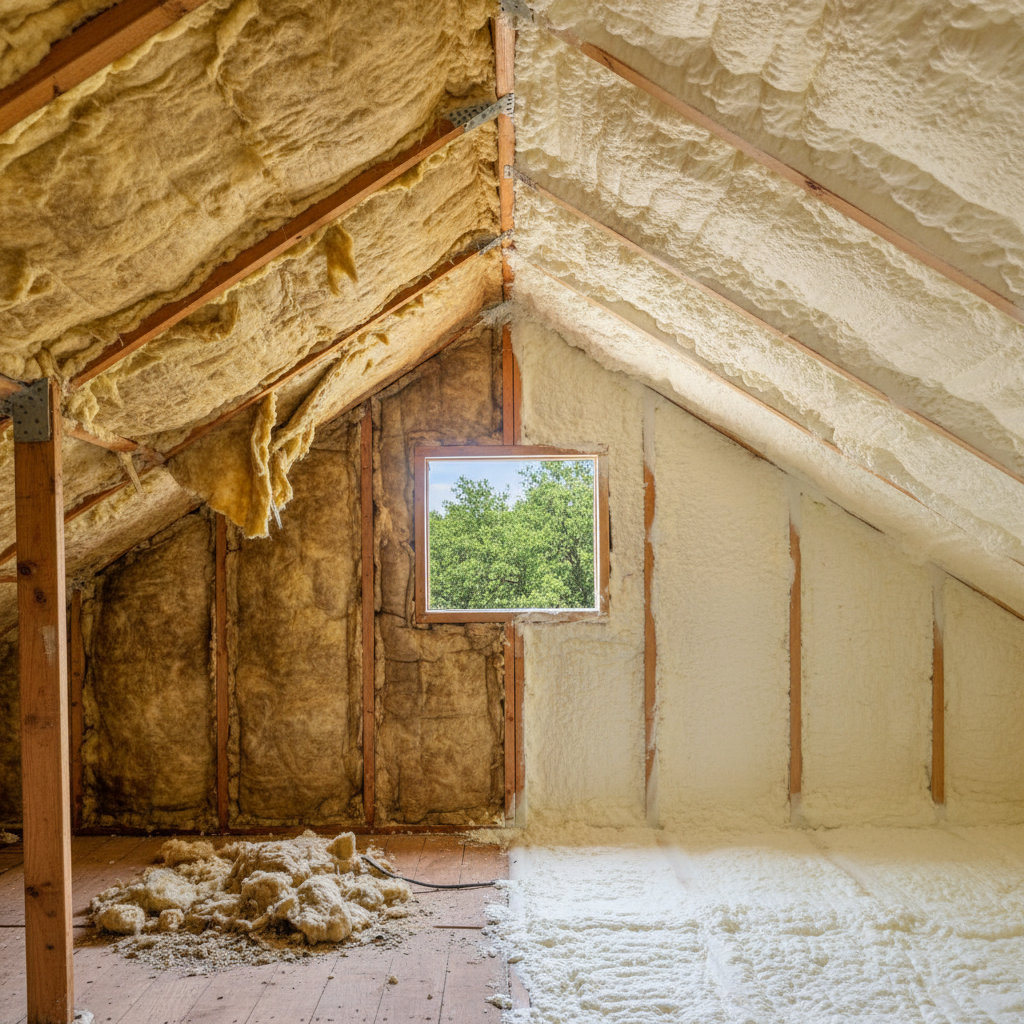
Alright, let's talk about closed cell spray foam. You've probably heard it's fantastic for insulation, and honestly, it really is. But when you start digging into it, you might come across a couple of different ways to get it installed: a full application or something called 'flash and batt.' So, what's the real difference, and which one makes the most sense for your home right here in Converse?
Full Closed Cell Spray Foam: The Whole Shebang
This method is pretty much what it sounds like. We come in and spray closed cell foam right onto the surface – usually the underside of your roof deck or the inside of your exterior walls – until we hit the R-value you need. For many areas, especially up in the attic or around your main living spaces, this means a good 2 to 3 inches, sometimes even more, depending on what we're trying to accomplish.
Cost
Let's be straight: full closed cell spray foam generally costs more upfront. It uses more material, and it takes us longer to apply it correctly. You're paying for a top-tier product and a thorough installation, after all.
Durability & Performance
This is where full closed cell truly shines. It creates an incredibly strong, rigid air barrier. It won't settle, it won't sag, and it's practically waterproof. For homes in places like Converse, where we get those wild temperature swings and often high humidity, this stuff is a real fortress. It keeps your conditioned air inside and the Texas heat (or that occasional cold snap) out, no problem. Plus, it actually adds structural strength to your walls or roof deck, which is a nice little bonus.
Maintenance & Appearance
Once it's sprayed, you're done. No maintenance required. It forms a solid, uniform layer. As for how it looks, it's a hard, somewhat bumpy surface, usually off-white or yellowish. It's not designed to be pretty; it's designed to work. Most folks aren't staring at their insulation anyway, especially not in an attic or behind drywall.
Flash and Batt: A Mix-and-Match Approach
Now, flash and batt works a bit differently. With this technique, we spray a thinner layer of closed cell foam – typically around an inch or so – directly onto the sheathing or inside the wall cavity. This thin layer then acts as your main air and vapor barrier. Once that's cured, we fill the rest of the cavity with traditional batt insulation, like fiberglass or mineral wool, to meet the remaining R-value requirements.
Cost
Generally speaking, flash and batt is a more budget-friendly choice than a full closed cell application. You're using less of the pricier spray foam and making up the R-value with cheaper batt insulation. This can be a smart way to get some of the benefits of spray foam without the full expense.
Durability & Performance
It's good, but it's not quite the same as a full closed cell job. The thin layer of closed cell foam does an excellent job of air sealing and moisture control. That's a huge plus! However, the batt insulation part can still be vulnerable to some air movement if it isn't installed perfectly, and it doesn't offer the same structural rigidity or long-term moisture resistance as a full closed cell application. You get a great air seal, but the overall thermal performance might not be as consistent or as high as a full closed cell system over many, many years, especially if the batt insulation settles.
Maintenance & Appearance
Like full spray foam, the closed cell part needs no maintenance. The batt insulation, though, could potentially settle or get compressed over time, which might reduce how well it works. Appearance-wise, you'll see the thin foam layer, and then the batt insulation on top of it, so it's a two-part look.
Which One Should You Choose for Your Converse Home?
Here's my honest opinion, especially for homes around Converse, whether you're in a newer build near Kitty Hawk or an older place closer to downtown. If your budget allows, I almost always suggest a full closed cell spray foam application for attics and critical wall spaces. Why?
- Superior Air Sealing: It's simply the best at stopping air leaks, which is absolutely vital when you're battling our Texas heat and humidity.
- Moisture Control: Closed cell foam makes an amazing vapor barrier. This is a big deal here, helping prevent moisture problems that can lead to mold or rot.
- Long-Term Performance: It doesn't break down, settle, or lose its R-value over time. It's a